






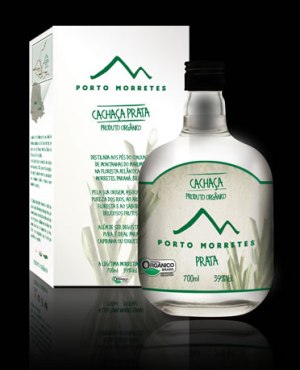
 Last fall a good friend of mine visited Brazil. I had asked him before the trip if he could find me a bottle of the Brazilian rum known as Cachaca (pronounced Ka sha sha). I was pleased when he returned just prior to Christmas with two small (170 ml) bottles of Port Morretes, the Prata (silver) and the Ouro (3-year-old premium).
In order to learn a little about the Porto Morrets Cachaca, I visited their website and with the help of Google Translate managed to decipher a bit about each spirit. The Porto Morretes Prata (Silver) is produced from sugar cane syrup which has been fermented with natural (home-made) yeasts without the use of chemical additives. The fermentation is carried out in a controlled hygienic process using stainless steel vats eliminating unintended contamination. The resulting fermented syrup is distilled upon modern copper pot stills, and the resulting distillate is rested for a considerable time period (I believe the website indicates about a year) in stainless steel tanks. This resting period softens and prepares the spirit prior to bottling making it suitable to drink neat or to serve in cocktails like the Brazilian Caipirinha.
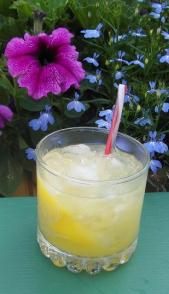
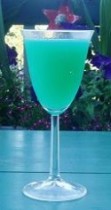
Amazing Tickle
Here is an excerpt from my full review:
Review: Porto Morretes (Prata) Cachaca
Of course, I needed to make a few cocktails. I began with a recipe of mine I call the Amazing Tickle which is my Caipirinha style recipe using lemon and orange rather than lime. I followed that up with a Margarita style recipe called the Macharita which uses Cachaca rather than Tequila at the heart of the recipe.
I hope you enjoy the review and the cocktail recipes which follow.
Cheers!
 Cachaca Thoquino has been produced for more than a 100 years by the Aquino family, in Sao da Barra, (the Campos area) north of Rio de Janeiro. This is a traditional sugar cane region within Brazil, and in fact the harvest of sugar cane in this area can be linked back to the earliest settlement of the Brazil sometime between the late 15th and early 16th centuries. The “Thomaz de Aquino” company is amongst the few distilling companies to own its own sugar cane plantations. Therefore the company controls the entire process from the cane field to the Cachaca in the glass.
 Leblon Cachaça
 The Rum Howler Blog