




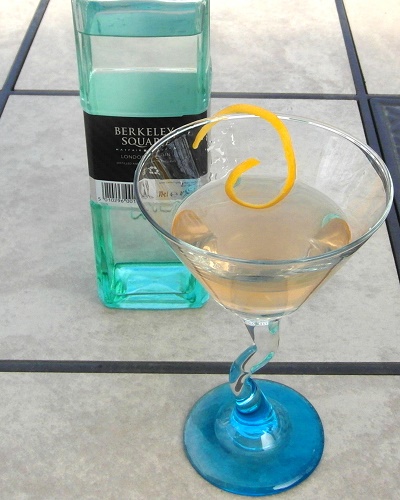


Here is a recipe which arrives to us from W.J. Tarling’s, Cafe Royal Cocktail Book (Coronation Edition) which was published in 1937. An interesting point about the Cafe Royal Cocktail Book is that Mr. Tarling used the left side margin to credit the ‘inventors’ of many of the cocktails. Presumably, the cocktails which are not credited in the book were well-known servings at the time and either did not need to be credited or the creators of these cocktails were unknown to Tarling.
The Abbey is one of these cocktails whose creator was not credited, and today there is very little information about where the cocktail originated. Modern versions of the cocktail often substitute Vermouth for Lillet (as I have done) or eliminate the aromatized wine altogether from the recipe.
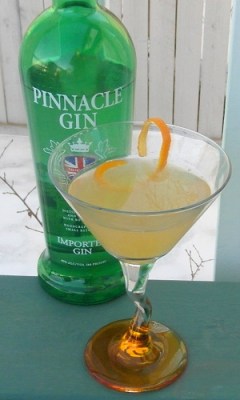 The elimination of aromatized wine from the recipe is probably because this serving only works well with fresh vermouth. Many persons (and unfortunately many bartenders) do not realize that aromatized wines will begin to oxidize immediately after being opened and exposed to the air. They can undergo a very undesirable change in the matter of only a few weeks. This oxidized flavour has a deleterious effect upon both the vermouth and the cocktail.
However, if fresh Vermouth is used, the Abbey Cocktail is quite wonderful.
The Abbey
2 oz Pinnacle Gin
1 oz Lillet (Sub Fresh Vermouth)
1 oz Orange Juice
1 dash Angostura Bitters
ice
orange peel garnish
Add the first five Ingredients into a cocktail Shaker with ice
Shake until the outside of the shaker begins to frost
Strain into a chilled cocktail glass
Garnish with a lemon zest twist
If you are interested in more cocktail recipes, please click this link (Cocktails and Recipes) for more of my mixed drink recipes!
Note: My review of Pinnacle Gin will publish tomorrow as the Gin Binge continues.
Chimo!
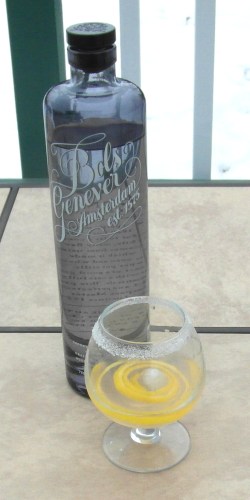 The formulation provided by Engels is rather hard to follow because it bases its construction upon another early recipe, the Fancy Cocktail, which in turn bases its construction upon a more generic serving which Engels simply calls the Gin Cocktail. Weaving my way through the tangle of recipes, I have brought forward Leo Engels’ Gin Crusta from 1878. (The cocktail was a favourite of my tasting group at a recent tasting I held where we were comparing both different styles of gin and different gin cocktails.)
 And celebrating Irish culture is not a bad thing; it was after all the Irish who first distilled “uisce beatha“, which translates into English as “the water of life“. I could go into a long and detailed etymology, but suffice it to say that “uisce beatha” is probably very close to the original form of the word which would later become “whiskey”.
 The truth is that no definitive starting point for the recipe we call the Gimlet is known for certain. It is also true that almost all bar servings evolve over time as better ingredients are discovered, and newer versions of servings are put forward. Even the word ‘cocktail’ has evolved over time from its beginnings when the term referred to a very specific style of bar drink to the present when it now refers to a large variety of bar drinks.
 The Rum Howler Blog