







 St. Patrick’s Day has rolled around one more time. (Although with a temperature outside at minus seventeen degrees Centigrade and still 40 centimeters of snow still residing on my back lawn it seems more like January than March.) In many places throughout the world, this is a day to revel in the Irish heritage which we either share by birth, or we share by spirit (on St. Patrick’s Day at least). We wear green; we attend parades; and some of us even drink green beer in what has become more of a secular holiday which celebrates Irish culture, than a religious holiday which celebrates the Patron Saint after which the day was first named.
And celebrating Irish culture is not a bad thing; it was after all the Irish who first distilled “uisce beatha“, which translates from Irish into English as “the water of life“. I could go into a long and detailed etymology, but suffice it to say that “uisce beatha” is probably very close to the original form of the word which would later become “whiskey”. My blog is full of reviews of this wonderful spirit, but I must admit it is sorely lacking in content dedicated to the Irish variety.
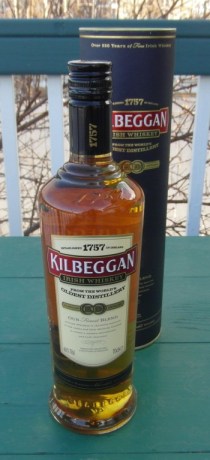
Today, I will go a small way towards correcting this imbalance by reviewing a whiskey from the Emerald Isle which embodies the character and the class of spirits we call Irish Whiskey; a spirit which can trace its heritage back to 1757, and makes the claim that it is linked to the oldest distillery in Ireland, the Kilbeggan Distillery.
Please click on the following excerpt to read the full review:
Review: Kilbeggan Irish Whiskey
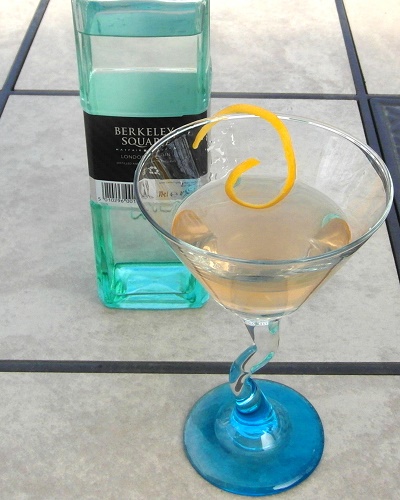
Of course I have include a nice cocktail for the Day of St. Pat, The Irish Mojito Swizzle.
Happy St. Patrick’s Day!
(Note: Sample for this review provided by the Alberta Beam Global team)
 Bulleit Bourbon is produced at the Four Roses Distillery in Lawrenceburg, Kentucky. The brand traces its heritage back to 1830 when tavern keeper Augustus Bulleit (after a few experimental trials) created the brand and began to market it locally and eventually to areas outside of Kentucky. As misfortune would have it, Augutus Bulleit disappeared while transporting some barrels of his bourbon to New Orleans, and the brand disappeared for over 100 years. In 1987, Tom Bulleit revived the brand which bears his great grandfather’s name. Today the brand is owned by the Diageo Conglomerate who market the product throughout North America and into Europe.
 According to the Wild Turkey website, Austin Nichols Wild Turkey Bourbon, is composed of a mash bill which includes three grains: corn from Kentucky and Indiana; barley from Montana; and rye grain from North Dakota. Apparently the yeast used in the fermentation has been cultured at the distillery and the actual strains used are kept a closely guarded secret. The whiskey is distilled to a low proof which results in less water needing to be added after maturation to bring the spirit to bottling strength. The belief is that this leads to a fuller more authentic ‘just from the barrel’ flavour.
 Pure Pot Still Irish Whiskey is traditionally made from a mash comprised of both malted and unmalted barley which is distilled in a pot still. This style of whiskey was apparently produced as a reaction to British taxes on malted whiskey which were introduced in 1802. To reduce the taxable amount on their whisky, Irish distillers began to add more unmalted barley into the distillation. The result was what we have come to know as Irish Pure Pot Still Whisky.
 Masterson’s Straight Rye Whiskey is distilled and aged in Canada, for a company from Sonoma California called 35 Maple Street. As a straight rye whiskey, the spirit must be barreled and aged in new American Oak, but Masterson’s also holds the distinction of being one of the very few straight rye whiskeys which is distilled from a mash of 100 % rye grain. It is bottled at 45% alcohol by volume. The whiskey is apparently named for the famous frontier lawman, William “Bat” Masterson.The choice is appropriate because Bat Masterson, who became famous in the American wild west, was actually born in Canada. Just as is Masterson’s 10-Year-Old Straight Rye Whiskey.
 The Rum Howler Blog