






The Johnnie Walker Brand of whisky is one of the most iconic brands in all of the world. With its unique square bottle, and the labels tilted a 24 degrees off-center, the company has created a strong brand image and is considered by many to be the quintessential Scottish whisky. The company was born in about 1820, and has grown steadily to become one of the most important Scottish whisky brands in the world today.
 The Black Label is a blended Scotch Whisky, which is composed of up to 40 malted and grain whiskies. The origins of the blend can be traced back to 1867, when Alexander Walker copyrighted and began to bottle Old Highland Whisky. In 1909 the name of the blend was changed to Johnnie Walker Black Label in reference to the color of the label which had become the generic means of identifying the blend amongst the Johnnie Walker customers.
At the time of my review (in 2010), all of the whiskies in the Black Label blend were aged at least 12 years, which gave this whisky a deeper character and smoothness than one normally associates with blended whiskies.
Here is a link to the review of the #44 spirit on my Rum Howler Top 100 Spirits Countdown.
#44 – Johnnie Walker Black Label
________________________________________________________________
You may follow my Countdown list of the 100 Best Spirits here: The Rum Howler 2015 – Top 100 Spirits
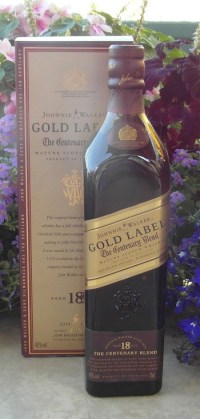 The Centenary Blend (now replaced by the younger Gold Label Reserve) was reputed to contain 15 separate single malt whiskies each aged a minimum of 18 years. Of these single malts four in particular have been noted as being key to the distinctive taste of Johnnie Walker Gold: Talisker generates the general character of the blend; Clynish generates the brine and seaside ambiance; Royal Lochnagar imparts the luxurious palate; and Cardhu lingers in the throat and provides the finish. I have read some claims that grain whiskies are in the blend as well, but whether that is true I have no confirmation. Grain Whiskies if present would certainly add vibrancy and character to the overall blend as well.
 I credit Jim Murray for not only recognizing that blends by their very nature have a capacity to be the superior whisky product, but actually saying it in 2007. The reason blends have the capacity to be superior is simple; the Master Blender and distillers have so many more choices to work with. Give any craftsmen more choices and they will have the capacity to do better. With Old Parr Superior Whiskey we have the result of just such blending and distilling freedom. A truly great whisky, one of the very best blended Scotch Whiskies I have tasted.
 However, according to Canadian Brand Ambassador, Dan Volway, the 1824 Series does not (at this time anyway) signal the end of age statements on The Macallan Single Malt Whiskies. The Fine Oak Cask and Sherry Oak Cask Single Malt series will each continue to carry age statements in the selected markets where they remain available (the USA and certain overseas markets).
 Glenglassaugh 26 Year Old Single Malt Scotch Whisky is one of the iconic vintage bottlings which was produced from spirit which had been distilled in 1984, and then had sat silently in a mixture of various oak barrels including both American Oak and ex sherry barrels. This whisky was bottled at 46% alcohol by volume (abv) sometime in 2010 and limited to a small production of 1002 bottles.
 The Rum Howler Blog