






 In 1856, John Gibson purchased 40 acres and built a distillery along the shore of the Monongahela River in Pennsylvania. By the turn of the century, the Gibson’s Distilling Company was the largest producer of rye whisky in North America. Unfortunately, early in the new century, fate dealt the company a tragic blow, in the name of Prohibition. Consumption of legal whisky all but dried up, and Gibson’s Distilling Company went bankrupt. In 1923, the entire contents of the distillery including the stills, the aging barrels, all of the remaining spirit, (and even the grain which was on site) was sold via Sherriff’s auction to Schenley Industries of New York. Fifty years later this whisky brand, which was born on the US side of the border in Pennsylvania, was resurrected by the brand owner at the Schenley Distillery in Valleyfield, Quebec. Now, of course, it has become one of the iconic brands of Canadian Whisky.
Of course the story continued and Shenley Distillers underwent re-organization at the end of the 20th century. As part of that reorganization, the Gibson’s Finest Whisky brand was purchased by William Grant & Sons in 2002. Some time after the acquisition, William Grant & Sons moved the production of Gibson’s Whisky from the Schenley plant in Valleyfield, Quebec to the Hiram Walker Distillery in Windsor, Ontario.
You may read my full review by clicking on the following excerpt:
Review: Gibson’s Finest Rare 18 Years Old Canadian Whisky
Please enjoy my review, and my suggested bar drink, The Old Fashioned Cocktail.
 Seagram’s has a rich and storied history which can be dated back to 1857 when the Granite Mills and Waterloo Distillery Company was formed. About seven years later, Joseph Seagram joined the company and by 1911 the company was known as Joseph E. Seagram & Sons. Today, over 100 years later, the Seagram name is still in use as a brand, but ownership of this whisky has been passed on to Diageo who now use the aged stocks at their Valleyfield Distillery in Quebec to produce the whisky.
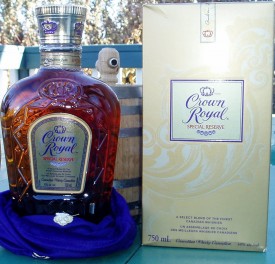 Crown Royal Canadian Whisky is currently produced in Gimli, Manitoba, at the Crown Royal Distillery. The distillery and the brand are owned by Diageo, and I think it is fair to say that Crown Royal is Diageo’s flagship Canadian whisky brand. In 1992, a premium version of Crown Royal was introduced as Crown Royal Special Reserve. This whisky was produced from specially selected casks which were tasted and monitored closely by the Crown Royal Master Blender. These ‘premium casks’ represented whiskies with special character, and they were allowed to age longer with the aim of producing a more premium whisky.

 The Black Velvet brand has a long history in North America, originally produced at the Schenley Distillery in Valleyfield, Quebec in the late 1940s. The whisky was originally called Black Label; but because of the perceived smoothness of the whisky, the producers soon changed the name to Black Velvet. It has been a staple of the Canadian whisky scene ever since. It is now produced at the Black Velvet Distillery (also called the Palliser Distillery) in Lethbridge, Alberta.
 The Rum Howler Blog