






The Margarita based upon the 1953 Esquire Magazine formulation.
The Margarita Cocktail is perhaps the most popular cocktail in the entire world. Unfortunately for cocktail historians, the origin of this famous mixed drink is clouded as researchers and drinks companies have offered conflicting stories as to where and when the original Margarita was served. I’ll try to unravel some of the mystery in this two-part posting. This posting (Part 1) posits that perhaps a libation called the Tequila Daisy was the genesis of the Margarita.
This argument is bolstered as one of the earliest mention of a Margarita style bar drink is the Tequila Daisy from articles in the Syracuse Herald in 1936 (Source: Imbibe). The Spanish word for the daisy flower is Margarita, and it is easy to see how the Tequila Daisy Cocktail could have quickly became known in Mexico (or Spanish-speaking communities in the Southern USA) as the Margarita. Although the Syracuse Herald failed to provide a recipe for the Tequila Daisy, we can make a good guess as to the its construction by noting that the popular cocktail upon which the Tequila Daisy was based was the Brandy Daisy.
The original recipe for the Brandy Daisy (1876, Jerry Thomas, The Bartenders Guide (Second Edition)) is:
3 or 4 dashes gum syrup, 2 or 3 dashes of Curaçao liqueur, juice of half a small lemon, small wine-glass of brandy, and 2 dashes of Jamaica rum
Fill glass one-third full of shaved ice, Shake and strain and fill up with Seltzer water
If we swap out the Brandy and Rum in Jerry Thomas’s Daisy recipe for tequila, his recipe now bears a strong resemblance to the earliest known published Margarita Recipe (found in Esquire Magazine’s December 1953 issue):
1 ounce tequila, Dash of Triple Sec, Juice of 1/2 lime or lemon
Pour over crushed ice and stir, Serve in a Salt Rimmed Glass
Although this line of reasoning provides a clear path for how the Tequila Daisy became the Margarita, it does not address the question of the actual person (bartender) who gave the Margarita Cocktail its current form. I’ll tackle that issue later this week in Part 2 of this Summer Cocktail Posting.
In the meantime, here is a modern variation of the Margarita I developed using Casamigos Blanco Tequila and California grown Cara Cara Oranges:
____________________________________________________________________________________________________________________________________________________________________________________________________________
Cara Cara Oranges are a navel variety orange grown in California’s San Joaquin Valley. They have a bright orange peel with just a touch of a pinkish hue, and their interior flesh is distinctively pinkish similar to a pink grapefruit. The flavour of this orange is unique representing a sort of hybrid mixture of tangerine and traditional navel orange flavour with an unusual (but delightful) sweetness which is ideally suited for cocktails.
 Cara Cara Margarita
2 oz Casamigos Blanco Tequila
1 1/2 oz Fresh Squeezed Cara Cara Orange Juice
3/4 oz Fresh Squeezed Lime Juice
1/2 oz Orange Curacao
1/4 oz Simple Syrup (1:1)
Ice
Cara Cara Orange Peel
Add the first five ingredients into a metal shaker with ice
Shake until the sides of the shaker frost
Strain into a chilled martini glass
Garnish with a small peel of Cara Cara Orange
Enjoy!
If you are interested in more of my original cocktail recipes, please click this link (Cocktails and Recipes) for more of my mixed drink recipes!
________________________________________________________
Casamigos Tequila has been in the news recently as the brand was recently acquired by Diageo Spirits in a deal which was rumored (italics because the key work is rumored) to be potentially (note again the italics) worth up to $1,000,000,000.00 (yep those are italics again). I thought the recent acquisition was a good excuse to revisit my reviews for the Casamigos brands and I shall begin with the Blanco.
Here is a link to my revised Review:
Review: Casamigos Blanco Tequila
Chimo!
 At the center of this controversy is a lime cordial called Rose’s Lime, which according to those aforementioned ‘protectors of the cocktail’ must be used in the bar drink’s construction rather than sweetened lime juice. I did a bit of research, and discovered that the controversy over the Gimlet stretched back to at least 1953 when a description found in the Raymond Chandler novel, The Long Goodbye, stated:
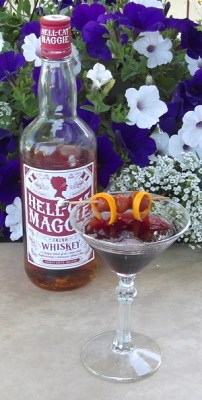 With that in mind, here is a mixed drink that combines Irish Whiskey with Sweet Vermouth and Bitters. The libation is called the Emerald, and it is a close relative of the popular North American cocktail, the Manhattan. It is important, when mixing an Emerald, to consider the pairing of Sweet Vermouth and Irish Whisky as each spirit has a multitude of brands, and the flavour profiles of each can differ significantly. As I happen to be mixing with a flavourful copper pot distilled Irish Whiskey, I chose the bold Cinzano Rosso which also has a complex flavour profile, one which I felt would pair well with my chosen Irish Whiskey, Hell-Cat Maggie.
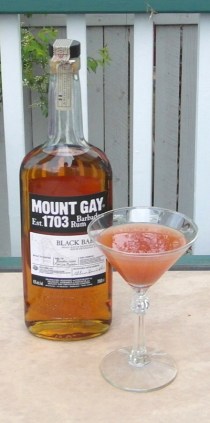 Things came together for this cocktail when I received a sample of Mount Gay’s Black Barrel Rum. The thought occurred to me that the complexity of Mount Gay Rum parallelled the complexity of Scotch Whisky. Would it be possible I wondered, to swap out not only Cherry Heering for Wisnak na Rumie, but also to swap out Scotch Whisky for Mount Gay Black Barrel Rum.
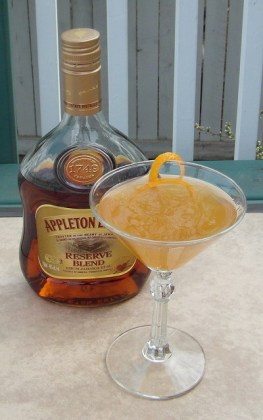 I have been revisiting some of those early cocktails with the idea that perhaps some of them should be polished up, and perhaps some should be dropped from my cocktail section entirely. However, after reviewing these early servings, I realized that every once in a while in those early days of my blog, I got it right. And that is the definitely the case with the recipe I am sharing today.
 The Rum Howler Blog