This past December, I noticed that Forty Creek Double Barrel Reserve Canadian Whisky had undergone a change. At least the bottle had changed. It was no longer sold in the tall sleek bottle which Forty Creek uses for all of their Special Edition Whiskies . It was now sold in the medium tall cylindrical bottle typical of their production whiskies.

The change made sense to me as Forty Creek Double Barrel has for quite a while now been in regular production and probably belongs in the main line-up rather than in a bottle which identifies it as a special release whisky. There was another more significant change however. Accompanying the bottle change was a significant price reduction. The whisky is now $39.95 (at the LCBO) vs. a previous price of $69.95. The significant price change begs the question, have the contents changed as well making this a less expensive whisky to produce?
So I reached out to the Campari team here in Alberta and asked them about the changes to the bottle and price (Campari has a majority stake in Forty Creek Whisky). I was told that so far as Alberta team knew the whisky was that same as always, but they had no objection to giving me a sample bottle so I could judge for myself. The bottle change was apparently done as a means to make the whisky more affordable.
When I received the sample bottle I set about testing whether I thought the whisky had actually changed or not. Fortunately there was a way to compare the most recent bottling (Lot 271) to the original bottling (Lot 240), because in the fall of 2009, I purchased and saved a few bottles from that initial release. So I selected one of those original bottles (Bottle number 07007 from Lot 240) to compare in a side by side tasting.
Before I began my comparison, I did a little research into how Forty Creek Double Barrel Reserve was produced so that I could see if there had been any obvious changes in production that I could discern over the past 11 years. In 2009, Forty Creek Double Barrel Whisky was announced as a spirit which had undergone two stages of aging. The first stage was the maturation of the individual whiskies which made up the blend (a corn whisky, a barley whisky and a rye whisky) which were each aged separately to maturity before being blended together. The corn whisky was aged in heavily charred white oak barrels; the rye whisky was aged in lightly charred white oak barrels; and the barley whisky was aged in medium charred white oak barrels. Each grain whisky and each barrel type was chosen by John Hall to add specific characteristics to the final blended whisky. Then the blended whisky was aged for a second time for two years in once-used Bourbon barrels. (The aging regimen for each component whisky and the two year time period for the finishing step was confirmed to me by John Hall in a 2011 interview.)

John Hall (Founder Forty Creek Whisky)
Then I happened to notice a bottle shot (from Lot 270) on the Forty Creek Website which seemed to indicate a change in the production method for the whisky about a year ago. If you look at the label below you will see that the whisky from Lot 270 was finished in once used bourbon barrels; however it is also stated that the whisky was aged in seasoned oak casks. I am not sure if this is meant to indicate part of the whisky, or all of the whisky; but the terminology of seasoned oak casks was new to me at least as far as Forty Creek Double Barrel Reserve was concerned. A seasoned cask for those who do not know is typically an older 2nd or third fill cask which is re-charred and then filled for a time with another spirit to ‘season’ the cask with it’s flavour. Since the casks which have been associated with Forty Creek Double Barrel Reserve in the past were never indicated to be seasoned barrels, one assumes that some of the casks used for finishing the whisky were now seasoned bourbon barrels, or that at least one of the component whiskies was now aged in a seasoned oak.

The new bottling (Lot 271) appears to represent more change. The label on the new bottling uses slightly different terminology to describe the second aging step. Rather than stating the liquid goes through two years of secondary aging in once-used bourbon barrels, the wording on the new label states that the liquid is finished in once-mellowed bourbon barrels. It’s a subtle difference, but that term ‘once-mellowed‘ might not mean the same thing as ‘once-used’. My instinct is to believe that this term actually refers to a second fill bourbon barrel rather than a first fill bourbon barrel. A first fill barrel would carry bourbon and corn whisky flavours which are are still fresh and strong. After this first fill, the bourbon flavours would be mellowed and ready for its second fill which would be when the latest version of Forty Creek Double Barrel would be finished. I could be wrong, but that is what the terminology leads me to believe.

I should note that the labeling (for all Lots of Forty Creek Double Barrel Reserve produced) mentions no aging time periods for either the first barreling step nor the finishing step. This means we have no way of knowing whether the overall maturity of the whisky has changed over time. It is probable (and indeed John Hall mentioned this to me several years ago) that each of the component whiskies which are aged separately, mature for different time periods. This makes an age statement somewhat misleading as much of the whisky will be older that the age statement would indicate. But it also means that if the overall whisky was getting older or younger, this change could occur without the consumer being aware of it just by looking at the label.
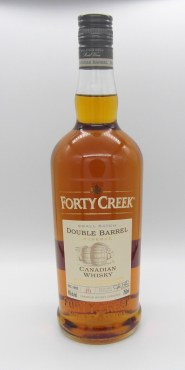
Forty Creek Double Barrel Reserve Lot 270 (circa 2020)

Forty Creek Double Barrel Reserve Lot 240 (circa 2009)
As well as looking into the production of each bottling over time to see if there might be differences of note, as part of my comparison of the two botlings I looked closely at the cosmetic appeal of both the bottle from lot 271 (left) and lot 240 (right). As you can see from my photos of each bottle, the new bottle for the Double Barrel whisky is a standard medium tall cylindrical bottle with a long slightly bubbled neck. The base is slightly smaller than the shoulders which give the bottle a tapered form. The bottle is sealed with a metallic pressed on closure. The label draws attention to the fact that this is considered a small batch release and my sample bottle apparently came from batch 271.
The older bottling has a much sexier visual appeal. As well, it is sealed with a nice corked closure rather than a metallic pressed on cap. Each bottle is not only identified by batch number, but each bottle was individually numbered as well. On a strictly, cosmetic level, I like the older bottle much more. That pressed on metallic cap in particular on the new bottle appears to give the brand more of a lower shelf appearance. Then again, if the that pressed on cap combined with the absence of individual bottle numbering and a less sexy bottle has saved me 30 bucks, then the cosmetic trade-off was probably worthwhile.
The more important comparison is of course the whisky inside those bottles. For that comparison I did three blind tastings where I was not told which sample was which. My wife poured the samples and placed them in dark glasses so that if there was a colour difference, I would not be aware of it. Each time I tasted the two whiskies side by side I found that it was quite easy to determine that I had a fairly strong preference for one sample over the other. That was because one of the samples had a more robust oak presence with firm notes of cedar, as well as strong bourbon-like corn flavours. The other sample was similar, but the oak was gentler, and the dry cedar-like flavour was not as assertive. It was also true that the indications of corn-like bourbon were not as pronounced. Another difference was that the sample with the more robust flavour profile seemed to have a structure and oak character which I associated with a more mature whisky. (That is a dangerous assumption, but it was my impression.)

In each case the sample which I preferred (3 out of 3 times) was the original Lot 240 Forty Creek Double Barrel Reserve Whisky. To quantify this difference, in terms of a score, the Lot 270 Forty Creek Double Barrel Whisky would score about 4 to 5 points lower than the Lot 240.
Of course the analysis and tastings which I conducted are hardly conclusive. I should note that in the past I have noted that Forty Creek Double Barrel Reserve tends to show some variance from batch to batch. I have reviewed the whisky on three separate occasions and my scores were (Lot 240 – 87 pts; Lot 247 – 89.5 pts; and Lot 263 -92.5 pts). So my results could very well be a result of batch variation, and not as I have implied, a result of a different aging regimen.
Time will tell the story, so perhaps I will revisit this comparison in a few years again. In the meantime, I think we can all agree that $39.95 per bottle sounds a darn sight better than $69.95 per bottle. And that is the only difference I can be one hundred per cent sure of.








 According to the original press releases, Canadian Club Chronicles Issue 2 is a 42-year-old whisky called The Dock Man. which celebrates dock workers who loaded sea freighters with crates of Canadian Club Whisk to be delivered whisky to bar owners and consumers during the American Prohibition. This ‘Dock Man’ bottling follows the launch of the original Canadian Club Chronicles: Issue 1 (Aged 41 Years) which I reviewed (here) earlier this year.


 The triticale grain that they use comes from a breeding program at Swift Current Saskatchewan with genetic lines going back to the CIMMYT breeding program in Obregon MX, which was originally started by the famous Norm Borlaug. This line of triticale has a unique flavour profile, and when grown under prairie conditions with strict attention to specific agronomic factors, John and Barb believe they are able to intensify these flavours found naturally in this grain variety.
 The Rum Howler Blog