






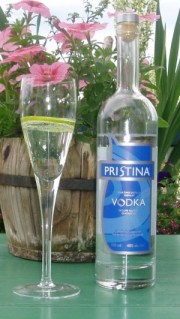
 Pristina Vodka is a quadruple distilled wheat Vodka produced in High River, Alberta in the foothills of the Rocky Mountains just south of Calgary. I have been a fan of Highwood Distillers for a while now; but I was not prepared for what greeted me when I opened a sample bottle Highwood’s Pristina Vodka. Maybe it was the uninspiring bottle and label, or maybe it is just a case of us Canadians being a little too self-conscious to believe we can be as good as everyone else in the world. Whatever the reason, when I put the Pristina in a flight of Vodka samples at a tasting where it was up against an Authentic Russian Vodka called Black Stallion, a real Polish Vodka called Alchemia Czysta, and a Vodka made in France called Grey Goose, I was not expecting what happened.
What happened was that every person at my tasting chose the same Vodka as their favourite, and every person said it wasn’t even close. That favourite, the clear head and shoulders winner without reservation in everybody’s opinion, was of course the Pristina Vodka from Highwood Distillers.
You may read my full review by clicking on the following excerpt:
Review: Pristina Vodka
Please enjoy my review and the included cocktail, the Vodka Tonic.
 Tanqueray Gin
 You may read my full review by clicking on the excerpt:
 Highwood Distillers
 Hacienda Corralejo was established in 1775 by Don Pedro Sanchez de Tagle in the Mexican State of Guanajuato. The distillery uses traditional methods of fermentation and distillation with clay ovens used to cook the agave and copper pot stills used for the distillation. The Blanco Tequila is an unaged spirit bottled directly from that copper pot still.
 I was given my sample of the Corralejo Blanco by a good friend who poured off a 200 ml sample from a full bottle he had been gifted. The bottle had sat in his cupboard for a few years; but was unopened until I was given my sample. I mention this so that the reader will know that the particular bottle I am reviewing was not from a current batch; rather it was from an unopened bottle which was several years old.
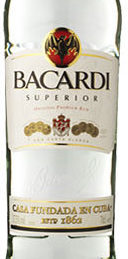 In 1862, Facundo Bacardi and his brother José bought the Santiago de Cuba Distillery and began to distill what would become the most popular commercial rum in the world. Using a method of charcoal filtering, and oak barrel aging along with a still of copper and cast iron, Facundo Bacardi created a smoother more refined version of the locally made rum. His smoother version of the spirit became local favourite, and over time, an international sensation.
 The Rum Howler Blog