The Rum Howler Blog

(A Website for Spirited Reviews)

  • Copyright

    Copyright is inherent when an original work is created. This means that the producer of original work is automatically granted copyright protection. This copyright protection not only exists in North America, but extends to other countries as well. Thus, all of the work produced on this blog is protected by copyright, including all of the pictures and all of the articles. These original works may not be copied or reused in any way whatsoever without the permission of the author, Chip Dykstra.
  • Cocktails and Recipes

    Click Image for Awesome Recipes

  • Industry Interviews

    Interviews

    Click the Image for Great Interviews with the Movers of Industry

  • The Rum Howler Interview (Good Food Revolution)

    Click on the Image to see my interview on Good Food Revolution

  • The Rum Howler Blog

    Unknown's avatar

  • Rum Reviews

  • Whisky Reviews

  • Gin Reviews

  • Tequila Reviews

  • Vodka Reviews

  • Enter your email address to subscribe to this blog and receive notifications of new posts by email.

    Join 1,092 other subscribers
  • Subscribe

  • Visitors

    • 15,534,719 pageviews since inception
  • Archives

  • Follow The Rum Howler Blog on WordPress.com

Archive for June, 2015

Martini Monday: The Gin Martini

Posted by Arctic Wolf on June 29, 2015

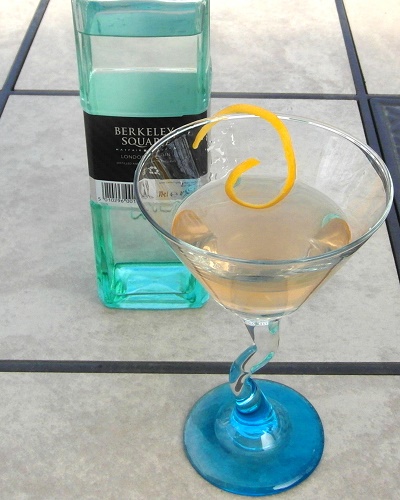
Gin Martini

Gin Martini

Gin appears to be the original Martini spirit. There is some speculation as to how exactly this bar drink evolved, the beginnings of this cocktail form was perhaps initiated as early as 1888 when a recipe for a bar drink which consisted of half a wine glass of Old Tom Gin, and half a wine glass of Vermouth was published (Johnson, Harry (1888), The New and Improved Illustrated Bartenders’ Manual; Or: How to Mix Drinks of the Present Style). Over time this simple bar drink evolved and changed into the present day Martini.  

Prohibition did its part to popularize the Martini as its main ingredient, Gin, was very easy for an illicit establishment to produce (illegally), and by the time prohibition ended, the Gin Martin may well have been the most popular bar drink served in North America.

Today, it remains a popular cocktail. Like the Vodka Martini (which arrived later on the scene), the Gin Martini can be served at varying degrees of dryness depending upon the amount of aromatized wine (usually vermouth) is used in its construction. The traditional recipes found in the cocktail guides from the 1920’s usually recommend a ratio of gin to vermouth of 2:1. Modern recipes contain much less vermouth, and in fact my brother-in-law’s favourite recipe calls for his cocktail glass to be rinsed with Vermouth only and the rest of the volume of his cocktail to be gin and garnish.

Traditional Gin Martini (cucumber garnish)

Traditional Gin Martini (cucumber garnish)

At the recent Belvedere Martini Seminar hosted by Ali Dedianko, Belvedere Vodka Global Ambassador, she made the point that we should perhaps explore also a larger range of garnishes than the typical olive or lemon peel. One of the garnishes she suggested was cucumber, and that is the direction I have chosen to go for this particular construction of my Gin Martini which combines No. 3 London Dry Gin and Stock Vermouth with thin slice of cucumber in an excellent Martini cocktail:

The following link will take you to my recipe page:

Gin Martini (with cucumber garnish)

Note: I made this point with respect to the traditional Vodka Martini, and it bears repeating again with respect to the Gin Martini. Once you open any bottle of vermouth, it is important that you realize that all aromatized wines have a very short shelf life. This is because the wine will begin to oxidize almost immediately, and after only one short week (even if the bottle is refrigerated) it’s flavour will have undergone a noticeable and undesirable change. I suspect in fact, that it is experiences with bad vermouth that have led many people to decrease its volume in the classic martini cocktail, not understanding that the vinegary component they are tasting is not a normal flavour component of good vermouth.

Please use fresh vermouth whenever you are serving Martini cocktails.

Posted in Cocktails & Recipes | Tagged: , , , , | 3 Comments »

Review: Michter’s US *1 Bourbon

Posted by Arctic Wolf on June 27, 2015

Michter'sThe Michter’s brand can trace its heritage to the Pennsylvania’s historic Bomberger’s Distillery, which in 1980 was declared a National Historic Landmark and is thought to have been up until the time of its closing, one of the oldest distilleries in the United States. In fact, the still house, the warehouse, and the jug house all date back to the 1840s.

The Mitcher’s brand itself was first distilled at the Bomberger facility in 1951 when it was owned by Louis Forman. Forman and his Master Distiller, Charles Everett Beam, apparently created the original whiskey that was named Michter’s Original Sour Mash Whiskey. The name was apparently a play on the names of Forman’s sons Michael and Peter. Over time the Bomberger distillery became associated with the Michter’s Whiskey and became known as the Michter’s Distillery. It was unfortunately closed in 1989 due to bankrupcy.

Since 2004, the Michter’s brand has been produced in Bardstown, Kentucky by Kentucky Bourbon Distillers with the brand currently owned by Chatham Imports, Inc.  The company has apparently built a new Michter’s Distillery in Louisville, Kentucky and has begun to produce their own spirit. This new production has not yet made its way into Michter’s US *1 Bourbon.

1878 Whiskey Cocktail over Ice

1878 Whiskey Cocktail over Ice

Here is a link to my full review:

Review: Michter’s US *1 Bourbon

“… The immediate nose is assertive with alcohol (from the high bottling proof), as well as spicy oak and sap, grassy tobacco and sweet butterscotch all reaching up and grabbing at me. There is a lot of fruit including both orange and banana peel, some yellow apple and even a few apricot brandy-like aromas …”

I hope you enjoy my review which includes a nice suggested recipe, the 1878 Whiskey Cocktail over Ice.

Chimo!

Posted in American Whiskey, Whisk(e)y, Whisk(e)y Review | Tagged: , , , , , , , | Comments Off on Review: Michter’s US *1 Bourbon

Review: AnestasiA Vodka

Posted by Arctic Wolf on June 26, 2015

AnestasiA VodkaANESTASIA VODKA was created as a result of founder, Yuliya Mamontova’s desire to create a luxury spirit in the United States. Yuliya’s passion was a result of her upbringing, as she learned the arts of fermentation and distillation as well as the expertise of marketing and packaging firsthand growing up in a family of European Vodka Producers.

Her luxury vodka, AnestasiA, is produced in Bend Oregon from corn which is sourced from Pacific Northwest farms and water which flows from Bend’s Cascade Mountains. According to the company website:

“The waters of this range flow through riverbeds of lava rock, and thereby avoid picking the sediment—metallic salts such as magnesium and calcium—present in most water sources. In fact, our waters contain 90% less of these compounds than your average drinking water. This makes our water remarkably ‘soft’, and results in AnestasiA vodka’s naturally derived purity.”

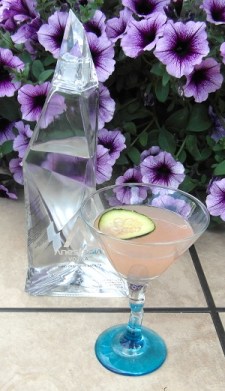
Tactical Equilibrium

Tactical Equilibrium

The AnestasiA spirit is five times distilled, and after the final distillation, the distillate is brought to bottling proof with the soft Northwest water. Then it is filtered a further five times through crushed lava rock, neutral charcoal, and Arkansas-derived quartz crystal. The final Vodka is bottled at 40 % alcohol by volume in a stunning decanter type bottle (shown to the left) which is made partially from recycled materials.

Founder, Yuliya Mamontova, reached out to me through my website, and asked me if I would agree to receive a bottle of her luxury Vodka to review.

Here is a link to that full review:

Review: AnestasiA Vodka

“… At the cold serving temperature I could detect absolutely no aroma above the glass, however, when I sipped the vodka I could taste a firm lemon zest with just a hint of grain spice. It is very pleasant especially with the lingering lightly sweet lightly spicy lemon flavour which coats the palate …”

Included with my review is a very nice cocktail which combines the AnestasiA Vodka with Gilbey’s Gin. I call it, Tactical Equilibrium.

Chimo!

Posted in Vodka, Vodka Reviews | Tagged: , , , , | Comments Off on Review: AnestasiA Vodka

Review: Captain Morgan Pineapple Rum

Posted by Arctic Wolf on June 25, 2015

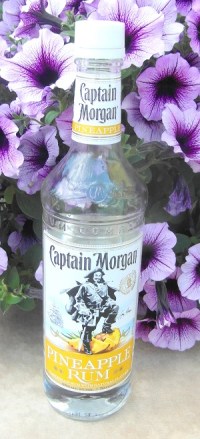
CM Pineapple SAM_1621On February 11, 2015, Captain Morgan introduced three flavors to its fleet of rums, CAPTAIN MORGAN® Pineapple Rum, CAPTAIN MORGAN® Coconut Rum, and CAPTAIN MORGAN® Grapefruit RumThese new Caribbean flavors are each five times distilled and of course made from cane molasses. Each of the expression blends natural flavors with CAPTAIN MORGAN® White Rum, resulting in a spirit which can be enjoyed as a summer cocktail mixer.

According to my Dan Kleinman, Vice President of Marketing, Rums for Diageo North America:

“This summer, we’re looking for consumers to flip over their hammocks and have a little fun with their mojitos and daiquiris by enjoying our new pineapple, coconut and grapefruit extensions. After last year’s successful launch of CAPTAIN MORGAN® White Rum, we wanted to expand our offerings in the category. These flavors allow adult fans to diversify their cocktails, providing them with a taste of the Caribbean no matter where they may be responsibly enjoying our products.”

Jump the Shark

Jump the Shark

The marketing team for Diageo sent me samples of all three of the new flavoured rums for review on my website, and I have decided to end this short review series with a look at Captain Morgan Pineapple Rum.

You may click the following link to read the full review:

Review: Captain Morgan Pineapple Rum

“… the pineapple aroma was quite luscious. Although there is an obvious and firm sugar cane-like sweetness which accompanies the pineapple scent, the intensity of the pineapple is very inviting and seems very natural …”

Please enjoy the review which includes the lighthearted cocktail, Jump the Shark.

Chimo!


Posted in Flavouerd Rums, Rum, Rum Reviews | Tagged: , , , , , , | Comments Off on Review: Captain Morgan Pineapple Rum

Inflategate?

Posted by Arctic Wolf on June 24, 2015

QuarterbackA few months ago I wrote a small piece about the NFL’s Deflategate controversy where I questioned the conduct of the NFL with respect to the entire Deflategate affair (see article here). The questions I raised concerning how the NFL and its officials handled the affair before the incident in question, during the game in which the supposed incident occurred, and afterwards remain unanswered, but recently two related incidents have given me cause to revisit what has transpired. The first incident was Tom Brady’s appeal of his suspension which was heard yesterday which of course makes this posting topical, and the second incident was the publication by the American Enterprise Institute of their analysis of the Wells Report. (See AEI Report here)

For those who do not know, the Wells Report was the investigative report provided to the NFL by Ted Wells which served as the basis for the NFL pressing forward with its punishment of the Patriots and Tom Brady for Tom allegedly (more probably than not) being involved in a scheme to deflate footballs just prior to their 2015 Conference Finals Game against the Indianapolis Colts.

The amazing conclusion of the American Enterprise Institute Report is that it is unlikely that the Patriots deflated the Footballs. The report casts serious doubts not only upon the interpretation and methodology used by Ted Wells, but also upon his  factual understanding of the underlying statistical analysis used in the report.

This might all be small news, except the American Enterprise Institute is the same body which provided a testimony to former National Football League (NFL) Commissioner Paul Tagliabue regarding the Bountygate scandal. Their testimony was reported to be a contributing factor in his decision to withdraw penalties against the New Orleans Saints players involved.

With respect to the Wells Report, The AEI analysis makes several startling revelations:

1) The Wells Report relies on unorthodox statistical procedures which were inconsistent with the actual statistical methodology the report describes.

The Wells Report’s conclusions are based primarily upon air pressure measurements of the footballs before the game and at halftime. What complicates things is that the NFL officials had two different pressure gauges which might have been used. These each gave slightly different readings. Even though the NFL official in charge reported using a specific pressure gauge before the game, Wells concludes he must have used the opposite gauge. The conclusions drawn from the Wells Report’s statistical analysis hinge heavily upon which gauge was actually used before the game and which gauge(s) were used at half time. Wells appears to believe his analysis takes all of this into account; unfortunately the math does not back this statement up.

2) In interpreting the results, the Wells Report failed to take into account other reasonable scenarios which would explain the findings.

Basically the report investigated only whether the evidence supported that deflation of New England Patriot footballs had occurred relative to the Indianapolis Colts footballs, and concluded that this relative deflation when it was found was evidence of tampering. It did not take into account an equally plausible theory that instead the Indianapolis Colts footballs may have been showing anomalous inflation. It turns out that the AEI report concludes that this was more likely scenario, and it suggests that this over inflation was caused not by the Colts, but through inconsistent treatment of the footballs by NFL staff when they were measuring the air pressures.

3) The Wells report ignored the predictions of the Ideal Gas Law and the basic physics of inflation and deflation relative to temperature change. 

It turns out that when basic physics is applied to the understanding of how footballs would inflate or deflate relative to temperature and ambient air pressure, the amount of deflation which was noted to have occurred with the New England Patriots balls was pretty much what science would have predicted given the circumstances. It also turns out that the Indianapolis Colts Footballs did not show the amount of deflation which would have been expected given the outside temperature. The AEI report concludes that the most reasonable explanation for this was that when all of the balls were tested during halftime, the Patriot balls were tested at the start of halftime when the footballs were still cold, and the Colt footballs were tested afterwards, after they had warmed up in the locker room. This hypothesis was backed up by the admission in the Wells Report that all of the Patriot balls were tested first (which would have been at the start of halftime), and that they had time to only test four of the Colts balls because halftime had ended. The AEI report states that allowing the Colts balls to warm up in the locker room by as little as fifteen minutes more than the Patriots balls was the probable cause for the relative inflation of these balls relative to the colder Patriots balls.

4) It is unlikely that the Patriots deflated the Footballs

The American Enterprise Institute Report concludes as follows:

The fact that the average pressure of the Colts balls was significantly above the prediction of the Ideal Gas Law, while that of the Patriots balls was not, is inconsistent with the findings of the Wells report. Our conclusion that the warming of the balls during halftime is the key factor overlooked in the Wells report is supported by the observation that the reading of the intercepted Patriots football, measured separately from the other Patriots balls, came in almost precisely at the prediction of the law. Under the hypothesis asserted by the Well report, the odds of this Patriots ball matching the Ideal Gas Law prediction were between 1 out of 3 and 1 out of 300. It is therefore unlikely that the Patriots deflated the footballs.

Posted in Howls | Tagged: , , , , | Comments Off on Inflategate?