






Distillerie Reimonenq (also referred to as Musee Du Rhum) was founded in 1916 by the Reimonenq family. The distillery, like most others on Guadeloupe, produces Rhum Agricole from distilled sugar cane juice. The fresh-cut cane is crushed by electric mills and the resulting ‘honey’ undergoes a 24 to 48 hour fermentation in open air vessels. The fermented ‘wine’ is distilled in a stainless steel column in the traditional french manner.
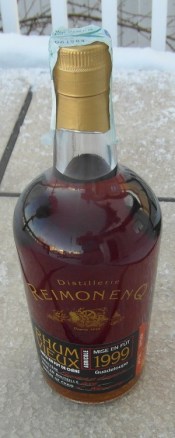 Incidentally, the word “rhum” is the French spelling for our English word “rum”. However, the differences between Rhum and Rum are much deeper than just a twist in spelling. This is because the french traditions of making rhum in the French West Indies differs from the Spanish and English traditions of rum production in the rest of the Caribbean. A major difference in the production of agricole rhum is that it is distilled from fermented sugar cane juice rather than fermented molasses. As well rhum agricole is usually single distilled to 70 per cent alcohol by volume (ABV), and then brought to bottling proof (50 % ABV) after it is aged. These differences in production translate into a very different flavour profile, one that is more floral than molasses based rum.
Here is a link to the review of the first of two #25 spirits on my Rum Howler Top 100 Spirits Countdown of the best spirits I have ever tasted.
#25a – Reimonenq Vieux 9 Year Old Rhum (1999)
________________________________________________________________
You may follow my Countdown list of the 100 Best Spirits here: The Rum Howler 2015 – Top 100 Spirits
Note: Time for a bit of a confession. After compiling and beginning to publish my list, I realized that I had neglected to sample the spectacular rhum from the Distillerie Reimonenq (located on the isle of Guadeloupe) when doing my summertime examinations. To remedy this situation I tasted it alongside similar scoring spirits afterwards, and then added it upon my list creating a tie for the #25 position. Thus we will call Reimonenq Vieux 9 Year Old Rhum (1999) the #25a spirit, and the spirit which has shared its place upon the countdown will be the #25b spirit (to be revealed later today).
 I find myself siding with Jim Murray as I find the lighter influence of the American oak barrel allows the whisky to express more fully the subtle nuances of oak and whisky flavours which can be drowned out by the strong sherry influence of a first fill Sherry barrel. Unfortunately for myself, The Macallan Fine Oak series has been discontinued in Canada, although it is my understanding that this series is still available south of the border in the USA.
 Note: Although the whiskey has no age statement, I did a little research and according to Davin’s De Kergommeax’s article in Whisky Advocate
 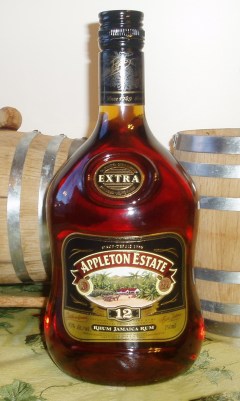 In November 2012 I revisited the Appleton 12 year Old Rum and found that my appreciation of the rum had increased substantially. Another visit to the bottle this year only reinforced that opinion. The Appleton 12 Year Old XO Rum has improved over the years (or perhaps my taste has).
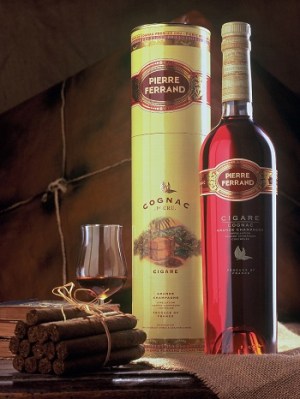 Pierre Ferrand Cigare was produced in very small quantities, created solely from aged eaux de vie produced within the 1st Cru de Cognac, specifically the Grande Champagne Cognac appellation of France. In producing the Cigare Cognac, the aim was to structure the final spirit such that it would be suitable for pairing with a fine Cigar, hence the name Pierre Ferrand Cigare. Although the final spirit has no age statement, according to the information provided to me, the Cognac is blended to achieve an average age of 25 years.
 The Rum Howler Blog