





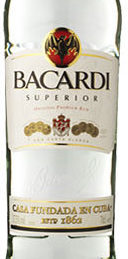
 In 1862, Facundo Bacardi and his brother José bought the Santiago de Cuba Distillery and began to distill what would become the most popular commercial rum in the world. Using a method of charcoal filtering, and oak barrel aging along with a still of copper and cast iron, Facundo Bacardi created a smoother more refined version of the locally made rum. His smoother version of the spirit became local favourite, and over time, an international sensation.
Bacardi Superior White Rum is a direct descendant of the original rum which Facundo Bacardi produced back in 1862. Although production methods have undoubtedly changed since then, the Bacardi White Rum is still produced using a method of oak barrel aging (for one to two years) and charcoal filtration.

Bacardi Daquiri
You may read my full review by clicking the following excerpt (link):
Review: Bacardi Superior White Rum
At the end of the review, I included 3 daiquiri recipes which I found on the Bacardi website named simply enough the Bacardi Daiquiri, Daiquiri No. 2, and Daiquiri No 3.
Please enjoy the review (originally posted April 10, 2011) and the three Daiquiri Recipes!
 A.D. Rattray
 As the
  Agavero is a blend of 100% blue agave Tequila (Reposado and Anejo), and the essence of the Damiana Flower. This is not a true Tequila spirit but rather a Tequila based liqueur. Lazaro Gallardo, the founder of Los Camichines Distillery, in Jalisco, Mexico, is credited with creating Agavero in 1857. It is produced as a sipping liqueur meant for those who want a lighter, sweeter and more refined Tequila experience.
 Cachaca Thoquino has been produced for more than a 100 years by the Aquino family, in Sao da Barra, (the Campos area) north of Rio de Janeiro. This is a traditional sugar cane region within Brazil, and in fact the harvest of sugar cane in this area can be linked back to the earliest settlement of the Brazil sometime between the late 15th and early 16th centuries. The “Thomaz de Aquino” company is amongst the few distilling companies to own its own sugar cane plantations. Therefore the company controls the entire process from the cane field to the Cachaca in the glass.
 The Rum Howler Blog